

Early Origins: The First Literary Synopsis and Real Reindeer
It might be very common these days to see Santa on a Sleigh flying in the sky. This association of Santa and reindeer is very recent. They comes from northern snowy parts. People living in Arctic regions have been using reindeer for very long period of time. In fact, the association of reindeer with Christmas is relatively modern, emerging in the 19th century through literature. patheos.com+1
Reindeer first became associated with Christmas-time in 1821 AD. An unknown poem appeared with much joy in a pamphlet in New York. It was titled as A New Year’s Present, to the Little Ones from Five to Twelve (also called The Children’s Friend). The poem begins with the phrases:
“Old Santeclaus with much delight / His reindeer drives this frosty night, O’er chimney-tops, and tracks of snow, To bring his yearly gifts to you.” Wikipedia+2henrylivingston.com+2
It was in 1821 for the first time reindeer pulling the sleigh is there associating it with Santa. The brochure also had pictures printed through lithography. Santa is wearing red clothing rather than wearing bishop’s clothes or any other traditional apparels. The first occurrence of reindeer linking with Christmas-time appeared in 1821 AD. Wikipedia+2patheos.com+2
If you enjoy exploring the stories behind famous animals, you might also like this piece. Malaika, one of the UK’s oldest lions and her remarkable life: https://pawtales.co.uk/mourning-malaika-one-of-the-uks-oldest-lions-dies-at-longleat-safari-park/
The idea of reindeer at this time was very new, and just one anonymous reindeer was famous. There was no recognised reindeer team, without a name. It was just like a character who gave off the vibe of a typical “gift-giver”. This was the fully developed new version of Santa as compared to before. WPR+2henrylivingston.com+2
The 1823 Game-Changer: Naming the Flying Eight
Two years after that, the 23rd of December 1823, another poem permanently shifted the people’s perception of Santa and reindeer. There is this famous introductory verse of a writing from St. Nicholas, “Twas the Night Before Christmas,”. It was first published anonymously in the New York magazine Troy Sentinel. Wikipedia+1
Santa is said to be arriving in a “tiny sleigh” carried by eight flying reindeer. Also the name of all those reindeer are given in that poem. They would later go on to be widely recognised.
“Now, Dasher! now, Dancer! now, Prancer and Vixen!
On, Comet! on, Cupid! on, Dunder and Blixem!” Wikipedia+1
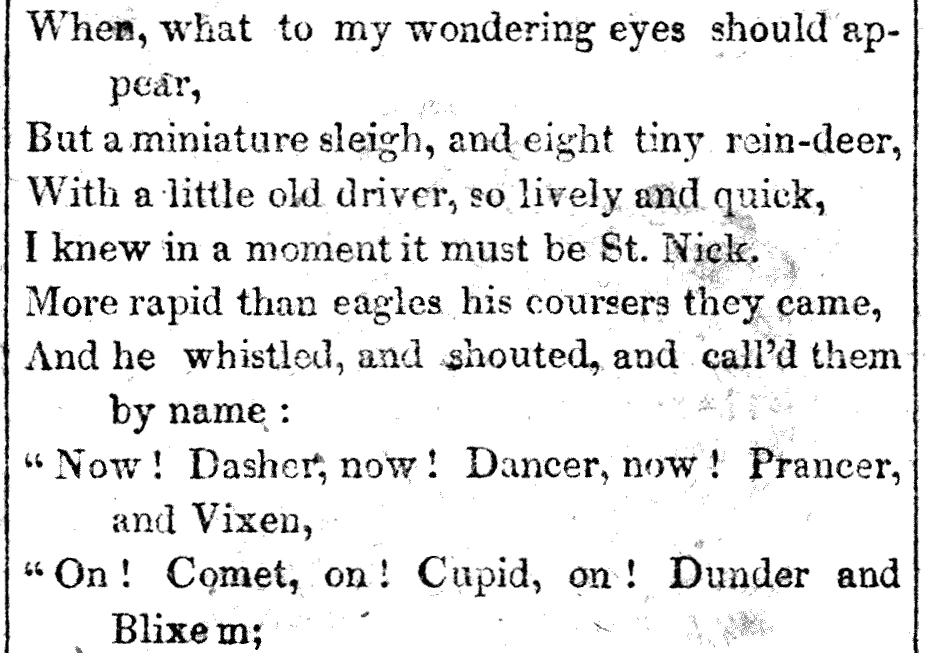
Fig: Text from the original publication of the poem in the Troy Sentinel, with the spellings “Dunder” and “Blixem”.
As a result, what started as a single nameless reindeer, grew into a full group of eight giving a feeling of some sense of mystery, energy, and emotion. This was giving the fairy tale vibe of Christmas-eve gift giver to the people. Many scholars suggest that the the author of this poem is Clement Clarke Moore,. He took the idea from the poem published in 1821. It is true that he expanded the concept of reindeer-sleigh to the group of eight. henrylivingston.com+2Wikipedia+2
When Moore prepared the compilation of his poems in 1844 he included this poem in that publication which strengthened the image of Santa and reindeer as an aspect of American Christmas which later evolved as an international Christmas custom. Wikipedia+1
From Dunder and Blixem to Donner and Blitzen — Evolving Names & Language
Interestingly, two of the original reindeer names—Dunder and Blixem—actually originate from Dutch phrases that represent thunder and lightning. Snopes+2henrylivingston.com+2
These names frequently changed in English-language papers over the course of 19th century. By the time that poem was published in 1837, “Dunder” was modified to “Donder” and “Blixem” became “Blixen” (rhyming as “Vixen”) knowingly or unknowingly. They were recognised as “Donner” and “Blitzen” in following editions including Moore’s work in 1844, both of these terms continue to be prevalent till date. Snopes+2Wikipedia+2
For readers curious about how animals have shaped culture, here’s a deep dive into the secret history of cats in the UK—from superstition to 10 Downing Street:
https://pawtales.co.uk/from-myth-to-ministry-the-secret-history-of-cats-in-the-uk-superstition-to-10-downing-street/
Dasher, Dancer, Prancer, Vixen, Comet, Cupid, Donner, and Blitzen are the traditional eight reindeer crew which are now widely popular. Wikipedia+1
The Ninth Reindeer — Enter Rudolph the Red-Nosed Reindeer
The group of eight reindeer powered Santa’s sleigh for over a hundred years. A new character (Rudolph the Red-Nosed reindeer) was there for the marketing narrative in 1939 by a department store Montgomery Ward. Rudolph who is recognised with his bright red nose becomes the ninth reindeer who also takes the spot as the leader of the team. Wikipedia+1
Since then, Rudolph has develops into an integral part of Santa’s reindeer mythos and is frequently features in the traditional team of sleigh-pullers in stories, musicals, movies and decorations all over the globe. Wikipedia+1
Why Reindeer? — Reasonable Bases + Artistic Leap
- Natural fit for winter imagery: Since reindeer are adapted to cold temperatures and snowy environments, they are an ideal choice for winter imagery. They are commonly in action to pull sledges by people who live in Arctic or sub-Arctic regions. In people’s heads, they were appropriate for a “winter sleigh” because of this real-world association. patheos.com+1
- Literary creativity: However, even though the shift from actually sled-pulling reindeer to magical airborne ones was completely fictitious, it touched a lot of individuals. The poem in 1823 didn’t only link reindeer to Santa, it made them leap, leap chimneys, and carry gifts over the night sky. That combination of familiar creatures and exotic adventure gave the tale its lasting charm. Wikipedia+2henrylivingston.com+2
- Symbol of wonder and winter: Reindeer naturally convey imagery of icy, bitterly cold winters and isolated northern regions, making them an appropriate setting for a Christmas Eve adventure. Their presence enhances the feeling of fantasy, freezing cold air, and suspense.
Additionally, if you like learning about how animals have helped humans, you may enjoy my article on British war dogs from WWI to Afghanistan.
https://pawtales.co.uk/the-history-of-british-war-dogs-wwi-to-afghanistan/
Legacy — From America in the 19th Century to the World’s Christmas Tradition
Over time, the image of Santa’s reindeer—first as a single pulling creature, then as a group of eight nicknamed flying deer, and ultimately as a nine-reindeer unit with Rudolph—became engrained in Christmas culture around the world as a result of the 1821 and 1823 poems.
We can see Santa’s reindeer everywhere these days, in songs, music, arts, cards, books, decorations and many more. Their tale builds a folktale across generations and countries by blending literary fiction with actual Arctic wildlife. As a result, when children hang their stockings on Christmas Eve, they imagine far more than a cheerful man delivering gifts. Instead, they picture deer-drawn magic soaring across the sky, and consequently, they imagine the soft sound of hoofbeats landing on balconies.
Conclusion
Their legend is an excellent representation of how tradition, daily life, and artistic telling can come together to create an eternally beautiful custom.
[…] Learn about the fascinating history of festive animals in our feature on the story of Santa’s reindeer and their magical Christmas journey. […]